Your homepage, as it loads today
Captured September 23, 2026 on a desktop browser. The numbers point to the findings below.
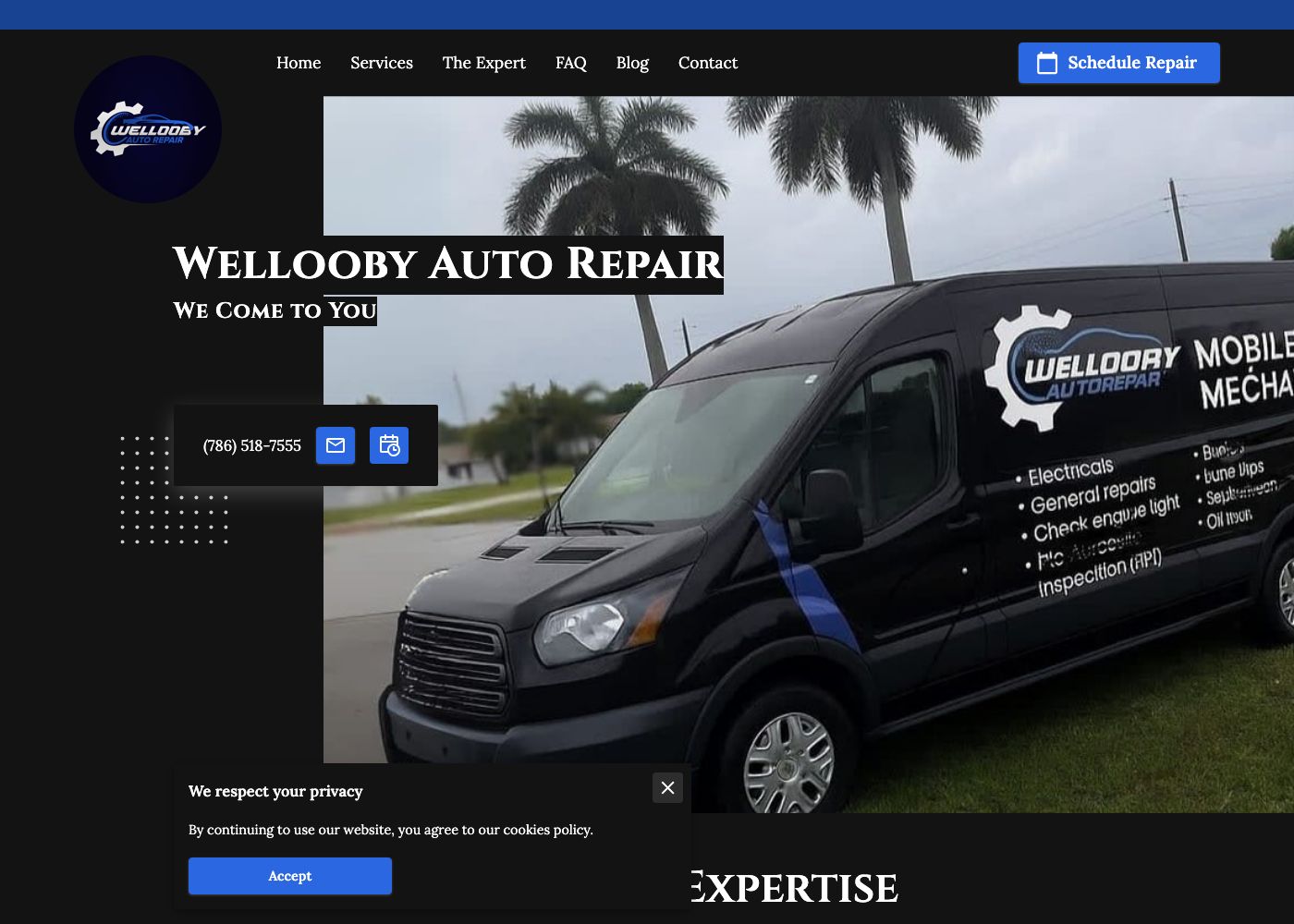
- 01We Come to You is the proposition and it is clearly stated, which is the right thing to lead a mobile repair page with.
- 02There is one image on the entire page. No van, no technician, no completed job, nothing that shows this is a real operation.
- 03Nothing says what a call-out costs or how quickly you arrive, which are the first two questions a stranded driver asks.
- 04The service area is given as two town names. A driver in Opa-locka or Hialeah cannot tell whether you come to them.
Your search listing, today and after
This is the first thing a prospective client sees, before they ever reach your site. Left is your live listing; right is what we would write.
A sound listing that names the service and the town. What it does not carry is the response time or the call-out fee, which is what a stranded driver is comparing.
Names the towns rather than the region, and puts the call-out fee in the snippet, which is what a driver choosing between mobile mechanics wants to see.
What we found, ranked by cost to you
Ordered by how much each one costs in inquiries and search visibility. Open any finding for the detail.
011.5 MB of HTML for 348 words, on a roadside phoneCriticalSpeed
The homepage ships roughly a megabyte and a half with 42 scripts to deliver about three hundred and fifty words. The customer for this service is standing next to a car that will not start, on mobile data, often with a weak signal. The page weight is felt hardest by exactly the person the business needs to reach.
02No call-out fee and no response timeCriticalLost jobs
These are the two questions a stranded driver asks before anything else. Neither is answered on the page, so the customer has to phone to find out whether they can afford you and whether you will arrive before the tow truck they are also considering.
03One photograph on the entire siteHighTrust
For mobile repair, photographs of the van, the technician and work in progress are the proof that this is a real operation rather than someone with a toolbox. A customer is agreeing to let a stranger come to their home or meet them on a verge, and one image gives them nothing to go on.
04The service area is two town namesHighLost jobs
Miami Gardens and North Miami are named and nothing else. A driver in Opa-locka, Hialeah or North Miami Beach cannot tell whether you come to them, and will call someone who says so plainly rather than phone to ask.
05No booking route, only a phone callHighLost jobs
There is no way to send a vehicle, a symptom, a photograph and a location. For mobile work that information is what lets you quote accurately and arrive with the right part, and collecting it up front is the difference between one visit and two.
06The viewport blocks zoomingMediumAccessibility
The viewport tag sets maximum-scale=1.0 and user-scalable=no, which stops a visitor pinching to zoom. Anyone who needs larger text, including a driver reading in bright sunlight at the roadside, cannot get it.
07The service area is not in the structured dataMediumVisibility
LocalBusiness, PostalAddress and GeoCoordinates are present and correct. For a mobile business the area covered matters more than the street address, and an explicit service area is what tells search engines which towns to show you in.
08348 words, long on positioning and short on detailMediumContent
The page says what the business is rather than what it does. Which repairs can be done at the roadside, which need a workshop, what parts are carried on the van: none of it is published, and all of it is what a customer is deciding on.
09No customer reviews on the pageLowReputation
Reviews matter more for mobile work than for a fixed shop, because there is no premises to visit and no sign on a building. None appear anywhere on the site.
10English only, in Miami GardensLowReach
The page has one language and no way to switch, in a service area where a large share of drivers would rather describe a fault in Spanish or Creole.
Six things a website has to do
Each area scored 0 to 10 against what a client-winning site for your trade needs to do.
What’s already working
- A business email on the company's own domain, which most of this batch does not manage
- LocalBusiness structured data with a postal address and geo coordinates already in place
- A clear We Come to You proposition, which is the right thing to lead a mobile repair page with
- A usable title and meta description naming mobile repair and Miami Gardens
- One H1, a canonical link and valid HTTPS, so the foundation is sound
How your business appears online
- Address
- Miami Gardens, with North Miami named as the second service area
- Phone
- (786) 518-7555
- customersupport@welloobyautorepair.com
- Listed on
Three weeks to a page that loads at the roadside
The basics are right. The work is weight, proof and the two questions a stranded driver asks.
Fee, area & proof
- The call-out fee and a stated response time published on the page, which are the first two questions a stranded driver asks
- Every town the van covers named, rather than the two currently listed
- Photographs of the van, the technician and completed roadside jobs, where the site has one image today
- Design mockups of the homepage and a service area page, with two rounds of feedback before anything is built
Weight & booking
- The page rebuilt to a fraction of its current 1.5 MB, so it loads on a weak mobile signal at the roadside
- The viewport corrected so a visitor can pinch to zoom, which it currently blocks
- A booking request that takes the vehicle, the symptom, a photograph, a location and a preferred time
- Standard site of up to 7 pages: Home, Roadside Repairs, Batteries & Starters, Diagnostics, Service Area, Pricing, Contact
- The service area added to the existing LocalBusiness markup, which otherwise stays as it is
Towns, reviews & launch
- A page for each main town in the service area, so each can rank for its own mobile mechanic search
- Customer reviews published, which carry more weight for mobile work than for a fixed shop
- Spanish versions of the core pages for the Miami Gardens market
- GA4 and Search Console verified, sitemap submitted, with a monthly report on calls and booking requests
Standard covers 5 to 7 pages. Anything marked optional is beyond the package and quoted at $100 per page before work starts.