Your homepage, as it loads today
Captured September 24, 2026 on a desktop browser. The numbers point to the findings below.
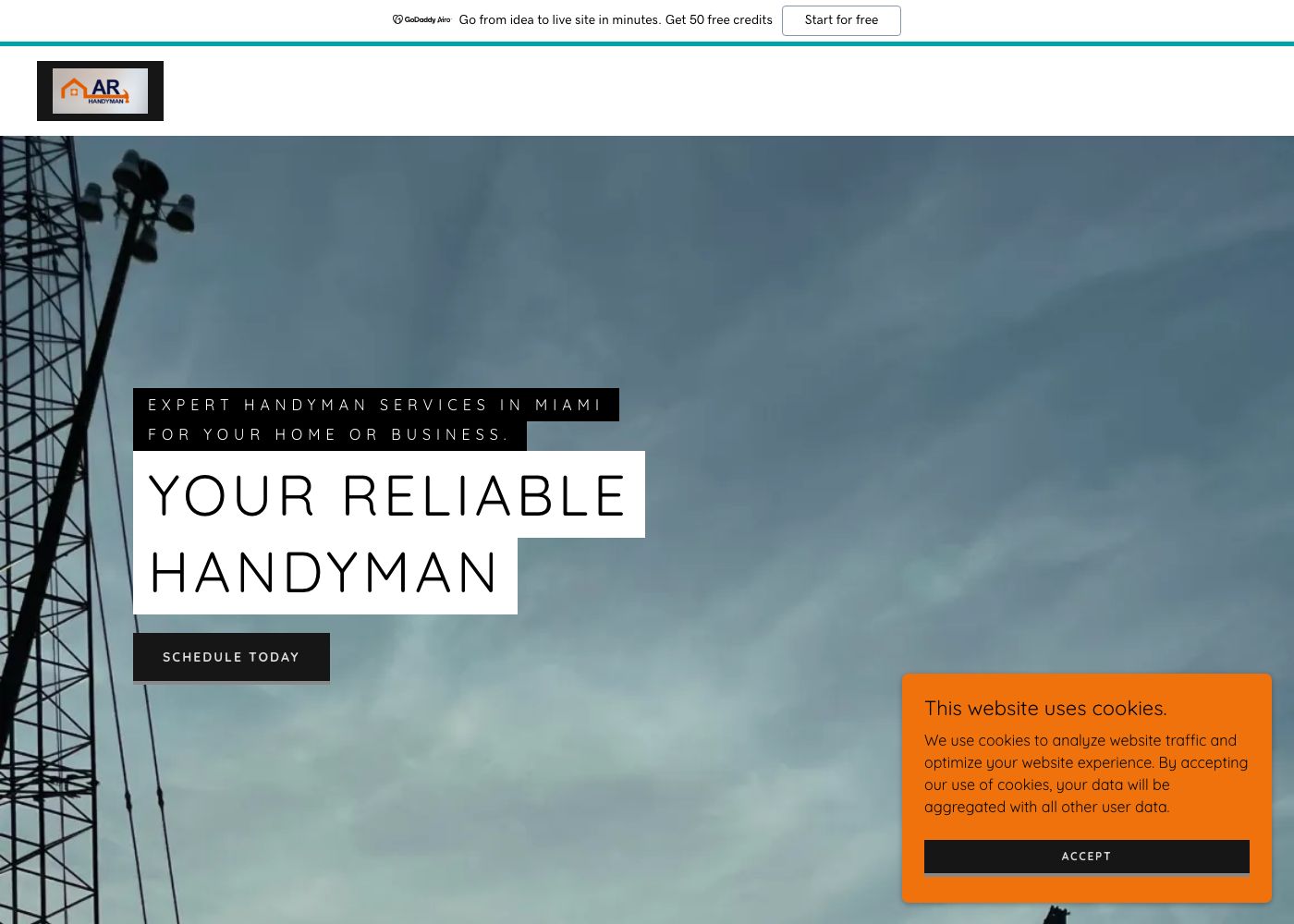
- 01Your Reliable Handyman is the hero line, and the whole first screen. It never says which jobs, and it is not an H1.
- 02A gallery of work follows the mission statement. The two images in the HTML carry no alt attribute, so a search engine reads past them.
- 03Customer Testimonials is a heading over an empty block. A visitor is promised social proof and shown nothing.
- 04The contact block: (786) 262-9098, Miami, FL, USA with no street, Today By Appointment, and the after-hours line at the very bottom.
Your search listing, today and after
This is the first thing a prospective client sees, before they ever reach your site. Left is your live listing; right is what we would write.
The title is the company name. Miami is in it by accident of naming, but no service is, and the snippet is assembled by Google from a page that names no jobs.
The after-hours line moves from the bottom of the contact block into the search result, where it does the most work. The job list belongs on the page underneath.
What we found, ranked by cost to you
Ordered by how much each one costs in inquiries and search visibility. Open any finding for the detail.
01No list of services anywhere on the pageCriticalLost jobs
There is a mission statement, a gallery and a quote form, but no service list in the delivered HTML. Drywall, doors, tile, fixtures, assembly, small plumbing: none of those words appear. A homeowner with a specific job cannot tell whether this handyman handles it, and a search engine has no job to rank the page for.
02No H1 element at allHighSearch
The page has no H1 in the delivered HTML. The hero line Your Reliable Handyman repeats four times in the markup, but none of it is marked as the page's main heading, so the single strongest on-page signal of what this page is about is absent.
03Customer Testimonials heading over an empty blockHighTrust
The heading is there and nothing follows it. A visitor sees a promise of social proof and then nothing, which reads worse than having no testimonial section at all, because it suggests there are none to show.
04No structured data of any kindHighVisibility
There is no machine-readable statement of the business name, phone, service area, hours or service list. Search engines infer all of it from a page that names no services, and the answer engines that read structured data first get nothing.
05No meta description and no canonicalHighSearch
The title tag is the company name only. There is no meta description, so Google assembles the snippet from a page with 242 words and no service in them, and there is no canonical link element. The only internal link in the HTML is to the homepage itself, so this is a single page with nowhere else to go.
06The business publishes no email addressMediumLost jobs
The quote form asks the customer for their email, but the business does not publish one of its own. A customer who wants to send a photo of the job, or who prefers not to call, has no way to reach the business in writing.
07The after-hours line is at the bottom of the contact blockMediumLost calls
The page states that after hours service is available for emergencies. That is the most commercially useful sentence on the site, and it sits last in the contact block under the hours line Today By Appointment. It belongs in a headline position.
08The address is Miami, FL, USA and there is no service areaMediumTrust
No street, no neighbourhoods and no radius. A homeowner in Kendall or Hialeah cannot tell whether the drive is on, and there is nothing on the page that places the business in any particular part of Miami.
09Both images have no alt attributeLowAccessibility
The two images in the HTML carry no alt attribute at all. A screen reader announces nothing for the gallery, and a search engine learns nothing from the only proof of work on the page.
10A builder subdomain, in English onlyLowReach
The site lives on arhandymanmiami.godaddysites.com rather than a domain the business owns, so any listing or business card that carries a shorter address is pointing somewhere else. The page is English only in a market where a large share of homeowners would rather book in Spanish.
Six things a website has to do
Each area scored 0 to 10 against what a client-winning site for your trade needs to do.
What’s already working
- The phone number, (786) 262-9098, published clearly in the contact block and again in the footer
- After hours service is available for emergencies, a sentence most handyman sites do not have and this one does
- A quote form that is already in place and working, ready for a service list to sit above it
- A gallery of work, which is the right proof device for the trade once the images carry alt text
- Valid HTTPS, a correct viewport and a light page at 103 KB with six scripts
How your business appears online
- Address
- Miami, FL, USA (no street published)
- Phone
- (786) 262-9098
- None published on the site
- Listed on
Three weeks to a site that earns the call
A rebuild, not a patch. Every item below answers a finding above.
The job list & the heading
- A plain list of the jobs the business takes, written with the owner, published above the quote form
- One H1 that names handyman services and Miami
- The Customer Testimonials section filled with real reviews, or removed
- A business email address published beside the phone number
- The after-hours and emergency line moved into a headline position
- Design mockups of the homepage and one service page, with two rounds of feedback before anything is built
Search, structure & proof
- Standard site of up to 7 pages: Home, Repairs, Installation & Assembly, Painting & Drywall, Gallery, About, Contact
- LocalBusiness structured data with name, phone, service area and hours
- A meta description written by the business rather than assembled by Google, and a canonical on every page
- Alt text on every gallery image, naming the job and the neighbourhood
- A stated service area, city by city, so a homeowner knows whether the drive is on
Domain, Spanish & measurement
- A branded domain registered and the site moved off the godaddysites.com subdomain, with the old address redirected
- Spanish copy for the core pages for the Miami market
- Listing text prepared for the main directories, all carrying one number, one address and the new web address
- GA4 and Search Console verified, sitemap submitted, with a monthly report on calls and quote requests
Standard covers 5 to 7 pages. Anything marked optional is beyond the package and quoted at $100 per page before work starts.