Your homepage, as it loads today
Captured September 23, 2026 on a desktop browser. The numbers point to the findings below.
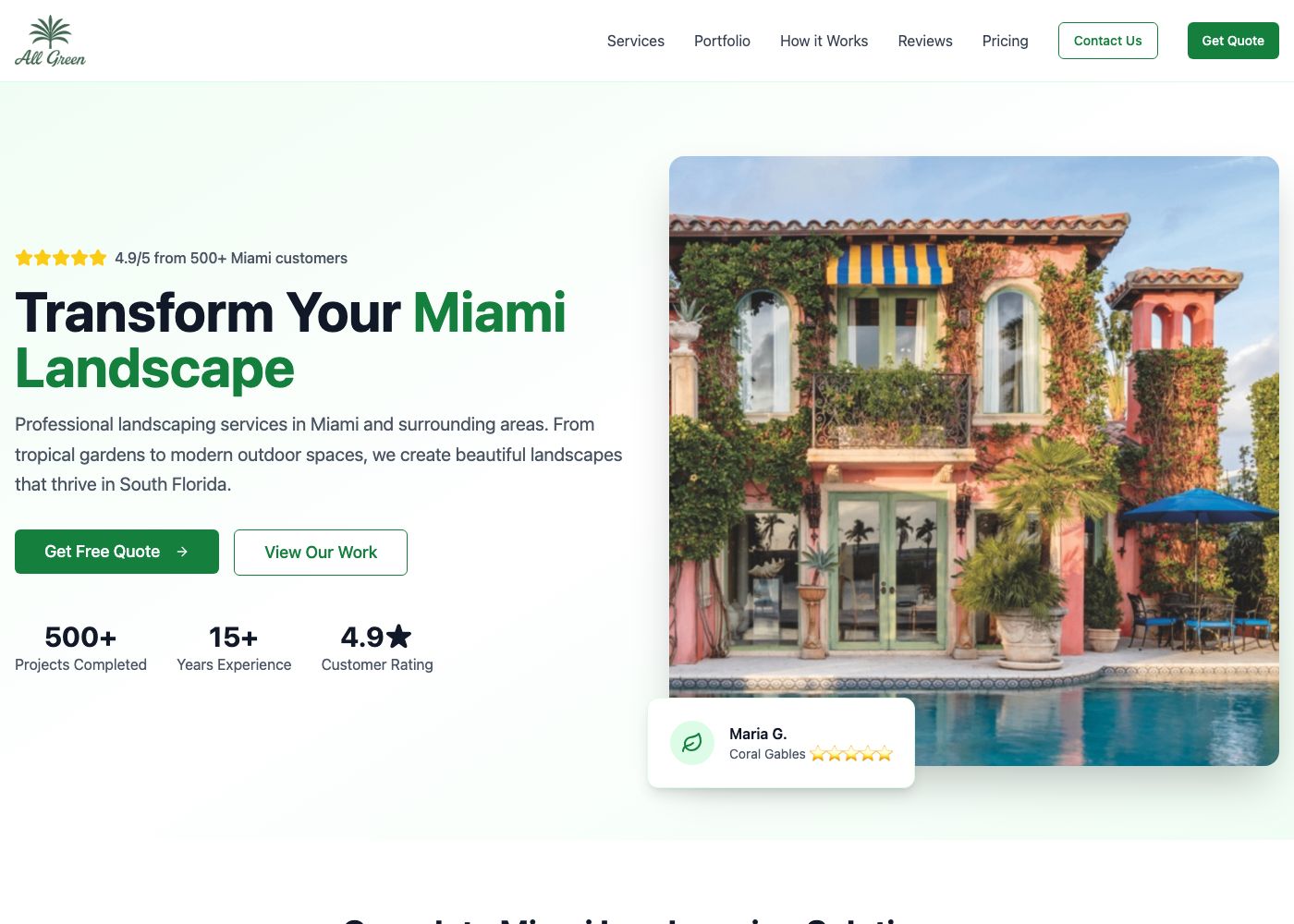
- 01The document a crawler receives is one kilobyte and four words. Everything on this screen is drawn by JavaScript after the page loads.
- 02No phone number or email appears in the HTML at all, so a directory or answer engine reading the source finds no way to contact you.
- 03There are no images in the delivered document, so the portfolio that sells this trade depends entirely on JavaScript running.
- 04The meta description is well written and names design, installation and maintenance. It is carrying the whole site on its own.
Your search listing, today and after
This is the first thing a prospective client sees, before they ever reach your site. Left is your live listing; right is what we would write.
The description is doing all the work, because it is nearly the only text in the document. The title names no service and no neighborhood.
Names the services in the title as well as the description, and points at a portfolio that will exist in the page rather than only in the browser.
What we found, ranked by cost to you
Ordered by how much each one costs in inquiries and search visibility. Open any finding for the detail.
01The phone number is not in the page at allCriticalLost inquiries
No phone number or email appears in the delivered HTML. They are drawn by JavaScript after load, so any crawler, directory aggregator or answer engine that reads source rather than rendering it finds no way to contact this business. Those are the systems that populate listings and AI answers.
02Four words of content in the documentCriticalVisibility
The page ships one kilobyte of HTML containing about four words of readable text. Google usually renders JavaScript and will probably see the finished page, but every step of that is a dependency and a delay, and anything that does not run a full browser sees an essentially empty site.
03No structured data of any kindCriticalVisibility
There is no machine-readable record of the business: no name, address, phone, hours, service area or coordinates. On a site whose content is already invisible without JavaScript, structured data is the one thing that could describe the business reliably, and it is absent.
04No H1 and no canonical linkHighSearch
There is no H1 in the document, so the strongest heading signal is unused, and no canonical, so the www and non-www versions can be indexed as separate pages. Both are single lines in the source.
05No portfolio in the documentHighLost inquiries
There are zero images in the delivered HTML. Landscaping is bought on before and after photographs, and here they exist only once JavaScript has run, so they are invisible to image search and to anything indexing the source.
06Nothing renders until the JavaScript runsMediumSpeed
Because no content ships in the HTML, a visitor on a phone sees nothing at all until the scripts download and execute. On a weak connection in a yard, that is the difference between a visitor and a bounce.
07The listings may be the only machine-readable sourceMediumVisibility
With no contact details in the HTML and no structured data, directory listings could be the only place a machine can read this business's phone number. That makes them load-bearing, and they were not verified in this pass.
08Design, installation and maintenance share one pageMediumSearch
Three services with three different intents and very different values, and maintenance is the one that produces recurring revenue. One page can rank for one of them, once there is a page with content in it.
09No storm season contentLowContent
Tree and yard work before hurricane season is predictable demand in South Florida that customers search for by name, and nothing on the site speaks to it.
10No Spanish versionLowReach
The site has one language and no way to switch, in a market where a large share of homeowners would rather arrange yard work in Spanish.
Six things a website has to do
Each area scored 0 to 10 against what a client-winning site for your trade needs to do.
What’s already working
- A meta description that is specific and well written, naming design, installation and maintenance
- A short, memorable domain with the business name in it, on valid HTTPS
- A correct mobile viewport, so the page reflows properly once it has rendered
- A clean, fast-loading shell with only two scripts, which is a good base to server-render into
How your business appears online
- Address
- Not published in the HTML. The record gives a Miami and South Florida service area
- Phone
- Not present in the delivered HTML; the record holds a contact number
- None published on the site
- Listed on
Three weeks to a site machines can read
The content exists in the browser. The work is putting it in the page as well.
Contact details in the page
- The phone number and email published in the HTML itself, as a tap-to-call link, not only in JavaScript-rendered content
- An H1 and a canonical link added to the document
- LocalBusiness structured data with the phone, hours, service area and coordinates, where there is none today
- Design mockups of the homepage and a service page, with two rounds of feedback before anything is built
Server-rendered content
- The core content server-rendered so the headline, services and contact details exist in the document a crawler receives
- Standard site of up to 7 pages: Home, Landscape Design, Installation, Maintenance, Commercial, Portfolio, Contact
- A project portfolio with real images and written alt text, present in the HTML rather than drawn later
- An estimate request that accepts photographs of the space
- Maintenance given its own page, since it is the recurring revenue in this trade
Seasonal, Spanish & launch
- Storm season and hurricane preparation content, which is predictable seasonal demand in South Florida
- Spanish versions of the core pages for the Miami-Dade market
- Listing text prepared for Google, Yelp and Facebook, since they are currently carrying the contact details alone
- GA4 and Search Console verified, sitemap submitted, with a monthly report on calls and estimate requests
Standard covers 5 to 7 pages. Anything marked optional is beyond the package and quoted at $100 per page before work starts.