Your homepage, as it loads today
Captured September 24, 2026 on a desktop browser. The numbers point to the findings below.
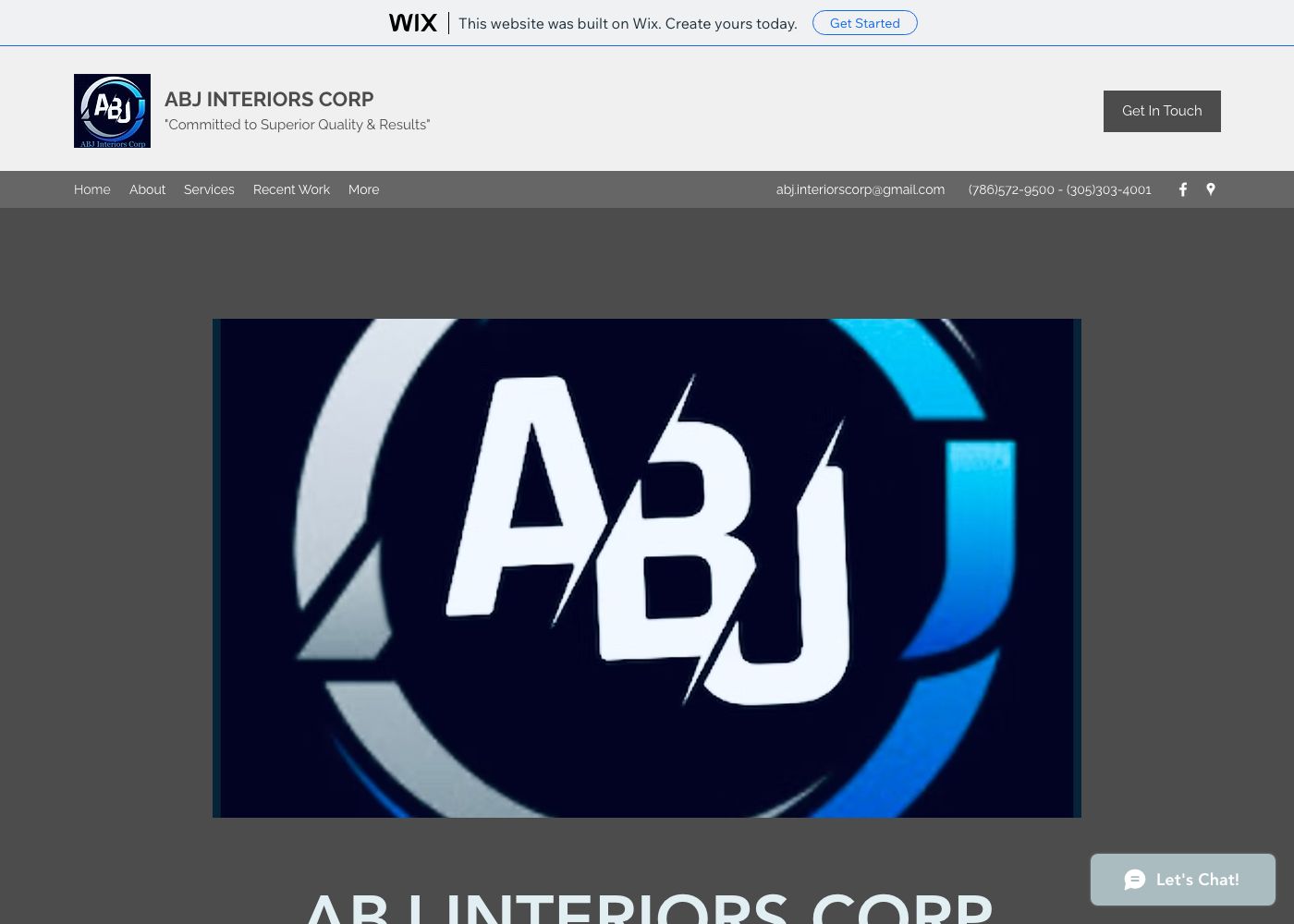
- 01The headline reads ABJ INTERIORS CORP while the browser tab reads Home | JACT Interiors Corp and the address bar reads jactremodeling. Three names, one page.
- 02The service cards: metal stud framing, drywall hanging, and a third titled simply SERVICE that repeats the drywall paragraph word for word.
- 03Two phone numbers written as (786)572-9500 - (305)303-4001, no space after the area code, neither a tel: link, and no indication of which to use for what.
- 04The Wix free-plan banner sits across the top of a page for a business that says it has served Miami since 2000.
Your search listing, today and after
This is the first thing a prospective client sees, before they ever reach your site. Left is your live listing; right is what we would write.
The title uses the builder default pattern with a name that does not match the page, and names no service and no city. The snippet is whatever Google picks.
One name, the two named services plus the work the reviews describe, the city, and the number in the snippet. Written against whichever name the business settles on.
What we found, ranked by cost to you
Ordered by how much each one costs in inquiries and search visibility. Open any finding for the detail.
01Three names for one business on one pageCriticalTrust
The title tag says JACT Interiors Corp, the H1 and body copy say ABJ INTERIORS CORP, the web address is jactremodeling.wixsite.com and the Facebook page is JACTRemodelingCorp. A referred customer given one name and finding the other cannot tell they have the right company, and the real reviews on the page lose their value to that doubt.
02A builder-default title and no meta descriptionHighSearch
The title tag is Home | JACT Interiors Corp, which names no service and no city. There is no meta description, so Google writes the sentence under the link from whatever text it finds. A page about framing and drywall in Miami currently tells a search result neither of those things.
03No structured data of any kindHighVisibility
There is no machine-readable statement of the business name, the NW 22nd Street address, the phone numbers, hours or service area. Search engines infer all of it from rendered text, which on this page carries two names, and answer engines that read structured data get nothing.
04Neither phone number dials on a tapHighLost calls
Both numbers are plain text, written as (786)572-9500 - (305)303-4001 with no space after the area code and no tel: link. On a phone the customer has to copy the digits by hand, and nothing on the page says which number is for what.
05The third service card is titled SERVICE and duplicates the drywall copyMediumJobs
Only two services are named, metal stud framing and drywall hanging, and the third card is an unfinished slot repeating the paragraph above it. The reviews describe popcorn ceiling removal, drywall repair and single-room renovations, so the page under-sells the range the business already does.
06A portfolio of images with nothing describing themMediumJobs
The Recent Work section has no text in the delivered HTML, and twenty-five of the thirty-eight images on the page carry an empty alt attribute. A remodeling customer chooses on finished work, and here the finished work has no scope, no location and no timeline attached.
07No licence number or insurance statementMediumTrust
Florida requires a licence number in contractor advertising, and a remodeling customer looks for it before letting a crew into the house. Neither the licence nor proof of insurance appears anywhere on the page.
08A free-plan banner, a wixsite.com address and no year in the footerLowTrust
The site sits on a builder subdomain with the Wix free-plan banner across the top, and the copyright line carries no year. For a company claiming twenty-six years in business, the page reads as newer and smaller than it is.
09719 KB of HTML and 64 scripts for 671 wordsLowTechnical
HTTPS is valid, the canonical is present and the viewport is set, so nothing is broken. The payload is the standard cost of how the site is built, and it slows first paint on a phone for a page whose readable content is under seven hundred words.
Six things a website has to do
Each area scored 0 to 10 against what a client-winning site for your trade needs to do.
What’s already working
- Three testimonials with first names, locations, project types and separate scores for quality, service and value
- Contact details that are consistent wherever they appear on the page: one email, two numbers, one address
- A single H1, a valid certificate and a canonical link, so the technical basics are in place
- A stated history, serving Miami and surrounding areas since 2000, which is worth more once the name is settled
How your business appears online
- Address
- 1927 NW 22nd Street, Miami, FL 33142
- Phone
- (786) 572-9500 and (305) 303-4001, neither labelled
- abj.interiorscorp@gmail.com
- Listed on
- Facebook (JACTRemodelingCorp)
Three weeks to a site that earns the call
A rebuild, not a patch. Every item below answers a finding above.
One name, then the basics
- One business name chosen and applied to the title tag, the H1, the body copy and the Facebook page, so all four agree
- Both phone numbers formatted with a space after the area code, made tel: links and labelled
- The SERVICE card filled with a real third service or removed, and popcorn ceiling removal and room renovations added to the list
- A title tag and meta description that name drywall, framing and Miami
Structure, captions & trust
- HomeAndConstructionBusiness structured data with the NW 22nd Street address, phone, hours and service area
- Alt text on the 25 images that carry an empty attribute
- The Recent Work projects captioned with scope, location and duration
- The Florida licence number and insurance cover published in the footer of every page
Own domain & service pages
- Standard site of up to 7 pages on a domain the business owns under the chosen name: Home, Framing, Drywall, Ceilings, Room Renovations, About, Contact
- A project gallery organised by job type with before and after photography
- The three real reviews carried over and placed where a customer sees them first
- GA4 and Search Console verified, sitemap submitted, with a monthly report on calls and form submissions
Standard covers 5 to 7 pages. Anything marked optional is beyond the package and quoted at $100 per page before work starts.